

“First customers are integrating our ion trap quantum computers into data centers.”


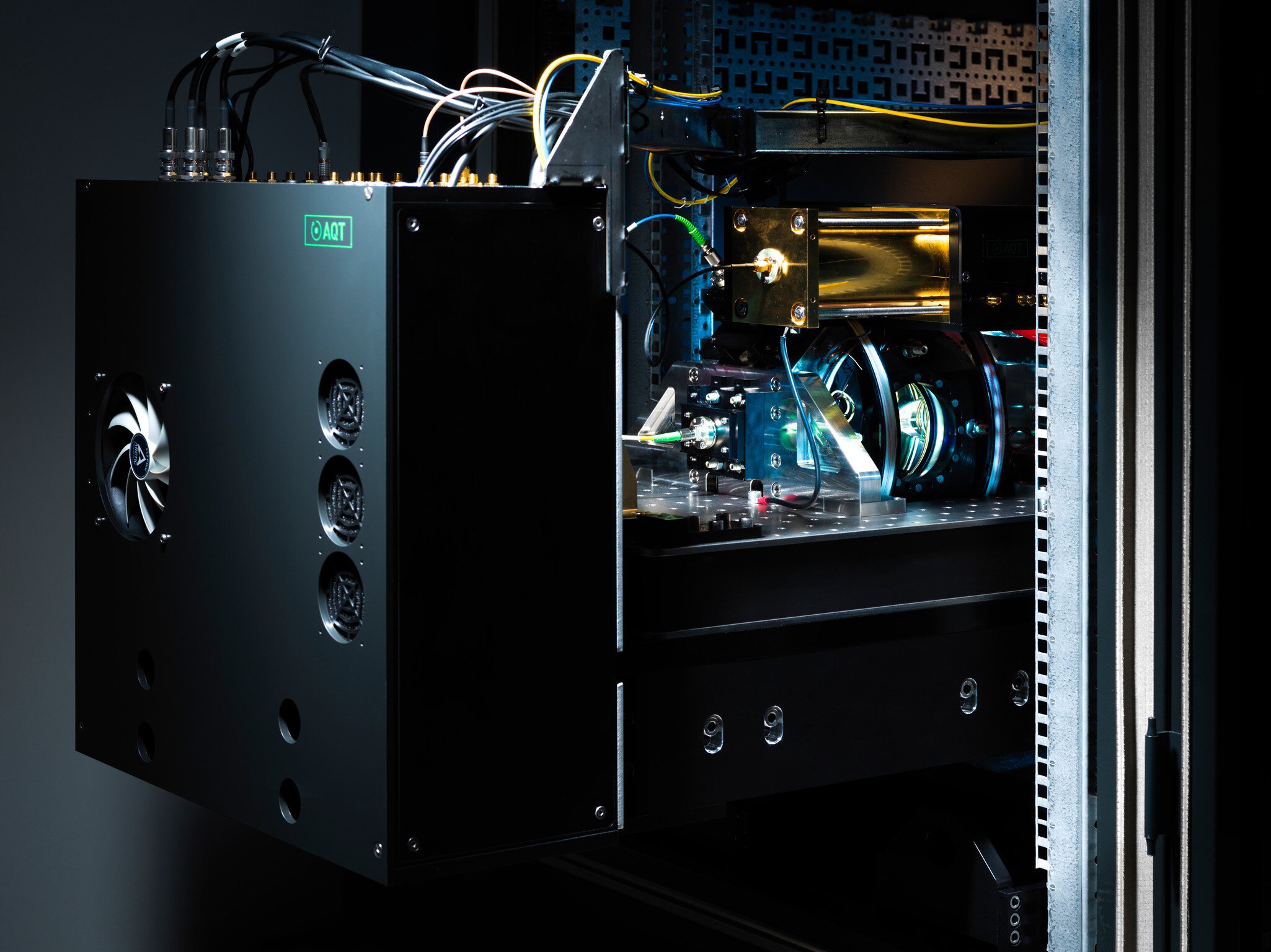
Since its founding in 2018, Alpine Quantum Technologies (AQT) has been developing quantum computers based on ion traps. Integrated into 19-inch racks, they run at room temperature with moderate power consumption of less than 2 kW. The young company recently delivered one such ion trap quantum computer with 20 qubits to the Leibniz Supercomputing Centre (LRZ) of the Bavarian Academy of Sciences. In this interview, Felix Rohde, who is responsible for business development at AQT and serves as CEO of AQT Germany GmbH, talks about the advantages of ion trap technology, the prospects for further scaling, and the importance of collaboration on the path to commercializing quantum computing.
Mr. Rohde, could you please briefly introduce AQT and AQT Germany to us?
Felix Rohde: We are a spin-off of the University of Innsbruck, which, alongside the University of Colorado Boulder in the US, has been one of the leading research institutions in the field of quantum computing with ions for decades. We benefit greatly from the expertise and critical mass of scientific groups there. There is a lively exchange with the groups working on ions. For us, this is the ideal ecosystem. AQT focused very early on quantum computers that are compatible with existing infrastructure in data centers—and has now succeeded in building powerful and very compact systems that are running in the first data centers. We founded AQT Germany last year, based in Munich. It distributes our cloud service worldwide and is responsible for the service and operation of the on-premise systems that we operate at the Leibniz Supercomputing Centre (LRZ) of the Bavarian Academy of Sciences and Humanities in Munich and at the Poznan Supercomputing and Networking Center (PCSS) in Poland. We provide a physicist or engineer as an operator who initially operates and maintains the systems. We also see synergies with Munich Quantum Valley, whose activities complement our ion trap technology well. Of course, we also hope to gain access to talent and collaborate with local companies.
How mature is your hardware in its eighth year since its founding?
Rohde: In terms of the robustness and stability of our systems, we have come a long way. We are in productive operation at the LRZ in Munich and are about to start at the PCSS. For laypeople, it is sometimes difficult to distinguish whether systems are still in the laboratory stage or whether they perform stably in productive operation over a longer period of time. We have managed to translate laboratory systems with a high degree of automation and system integration into robust technology. To be honest, of course, it must be said that these are still very sensitive devices. Nevertheless, there are not many on the global market that can deliver comparable performance over a longer period of time.
There are a wide variety of technology platforms for quantum computers. What approach does AQT take?
Rohde: We calculate with individual atoms. These are our qubits, the counterpart to the classic bit. We use ions, i.e., charged atoms. The fact that they are charged allows them to be captured and controlled with a so-called radio frequency trap—a Paul trap. Such a trap can be used to form stable ion crystals, i.e., a chain of ions strung together with a very long lifetime in the trap. This allows us to calculate continuously over several days without having to reload ions. Selected quantum mechanical states of the individual ions define the logical states of the quantum bits and can be manipulated with laser light. This is complex, but the technology is already so advanced that hundreds of logical operations can be performed in succession.
What are the key advantages of ion trap technology?
Rohde: A major advantage of using ions is that the qubits are identical. They are, so to speak, perfect quantum bits and do not have to be created by human hands. This is a major advantage over other approaches that require massive investment in the fabrication of their quantum bits. Trapped ions are characterized by low error rates and long coherence times. Together with what is known as “all-to-all connectivity,” i.e., the ability to execute logic gates directly on any ion pair in the chain, these properties ensure that ions currently offer the best performance of all approaches.
Your quantum computers are so compact that they fit into standard 19-inch racks. How does this rack integration support your market launch strategy?
Rohde: This integration specifically addresses today's largest market for on-premise systems—i.e., systems that run at the customer's site—high-performance computing (HPC) data centers. There is consensus in the community that quantum computers will first demonstrate their advantages when they are part of an HPC infrastructure. QPUs will complement GPUs and CPUs as accelerators. They will be used precisely where quantum computers offer their advantages. AQT recognized this early on and has been serving this market. We are the first ion trap provider to actually operate systems in HPC environments and work with operators on even closer integration. Initial results from operations at the LRZ will be published soon, and users at the PCSS in Poznan are also getting ready for their first computing tasks.
Your ion trap platform currently has 20 qubits. What is your roadmap for further scaling?
Rohde: We are focusing all our energy on developing the next generation of systems. This involves higher quality, faster throughput, and a higher number of qubits. Unlike many others, we deliberately do not publish a roadmap, as experience shows that these are often overly ambitious and need to be corrected quickly.
How are you approaching scaling?
Rohde: On the one hand, we are working intensively on this internally. But we are also consciously seeking collaborations and networks. In the EU's Quantum Flagship program Millenion, we are driving forward the vision of a 1,000-qubit computer in a consortium together with many European partners. The strategy initially envisages a scalable, modular 100-qubit system as an interim goal, which can be expanded to 1,000 qubits. In addition, there is Europe's ion trap chip pilot line, CHAMP-ION. This network promotes innovation in the field of ion trap chips and strengthens the European ecosystem.
AQT also cooperates with corporations from the telecommunications and financial sectors, start-ups from various countries, and research institutions. The spectrum ranges from research to application. How strategically important do you consider these collaborations to be?
Rohde: It is exciting to develop technology with large corporations as well as small start-ups and scientific groups. The entire “quantum stack”, from application to algorithms, compilation, firmware, and hardware, is incredibly complex. AQT focuses on its core expertise, the development of hardware and firmware up to the so-called SDK connector, and the software interface to our quantum computers. Automation, system integration, and monitoring play a major role in this. For areas where there are already good solutions on the market, such as software development kits (SDK), we don't want to reinvent the wheel but rather cooperate with the best partners worldwide.
Final question: AQT has been represented at World of Quantum since its inception. How do you experience our trade fair and its development?
Rohde: As a hardware company, we are deeply rooted in the photonics community—also in terms of our suppliers. We meet many laser companies and manufacturers of components for our systems there. That's why we put a lot of effort into it and were rewarded with a very large turnout in 2025. The trade fair is important for AQT's visibility. Given the number of visitors from potential customer industries, such as cloud users or those interested in our hardware, we would like to see even more visitors. Important players in quantum technologies are represented at World of Quantum. So, we can all look forward to World of Quantum 2027.