

Full Speed Ahead for Quantum Technologies

Germany is accelerating its efforts in quantum technologies. As one of six key technologies identified in Germany’s High-Tech Agenda (HTAD), quantum technologies are now a priority for government research funding. Research infrastructure is already expanding rapidly.
Germany aims to become one of the world's leading nations in quantum technologies by 2030. As part of its High-Tech Agenda (HTAD), the current federal government has presented a roadmap and defined milestones paving the way for market-ready products in quantum computing, quantum sensing and quantum communication. New innovation ecosystems are to emerge around pilot lines and quantum centers.
The aim is to overcome the "mid-tech trap", secure technological sovereignty and implement concrete applications in cancer diagnostics, road safety, satellite communications and quantum computing. To this end, two error-corrected quantum computers meeting leading European standards are to become operational. At least two startups are expected to enter their growth phase through major financing rounds backed by European venture capital. To support this development, the public sector is to act as an anchor customer, purchasing solutions from young quantum technology companies and generating significant revenue that will make them more attractive to private investors. Another priority is expanding education and training opportunities to strengthen the skilled workforce in this emerging industry.
Under the leadership of the Federal Ministry of Research, Technology and Space (BMFTR), Germany's High-Tech Agenda has been allocated a total budget of EUR 18 billion through the end of the legislative period in 2029. This funding is distributed across six key technologies: quantum technologies, microelectronics, biotechnology, artificial intelligence (AI), climate-neutral energy generation through fusion, and technologies for climate-neutral mobility, including the development of competitive battery production by 2035. Photonics plays a key enabling role across all six technology fields.
Joining Forces and Building New Infrastructure
Specifically, the quantum computing roadmap envisages at least three pilot lines within the EU's "Lab-to-Fab" network becoming operational this year. By 2029, at least three German data centers are to be equipped with quantum computers. Their software stacks are expected to be fully integrated at a globally competitive level by 2030, enabling computational operations using error-corrected logical qubits. By 2032, the goal is to demonstrate quantum advantage in two concrete practical applications.
The quantum sensing roadmap follows an equally ambitious schedule. As early as 2027, at least two technology transfer centers are expected to begin operations. There, industrial companies will collaborate with research organizations including the Max Planck Society, the Fraunhofer Society, the Helmholtz Association, the Leibniz Association (WGL), universities and the German National Metrology Institute (PTB) to advance quantum sensing for life sciences, environmental monitoring, geodesy, and aerospace applications.
Targets for 2030 include the early detection of diseases and monitoring of treatment outcomes, as well as the use of quantum-based gyroscopes, gradiometers, gravimeters and chronometers in satellites, navigation, mapping and environmental monitoring. Here, too, the stakeholders aim to demonstrate quantum advantage in practical applications from 2032 onwards.
Enormous Market Potential
In quantum communication, 2026 has already seen the commissioning of the second QUBE satellite and the completion of the QuNET initiative, which is embedded in the European initiative to establish a European Quantum Communication Infrastructure (EuroQCI). Plans for the coming years include launching a networking platform to facilitate the transfer of knowledge and technologies between industry and research, developing the first quantum repeaters for long-distance communication, and bringing quantum information networks into operation.
The three roadmaps and the plans to strengthen the skilled workforce are based on close cooperation between industry, research institutes, universities, and federal and state authorities. The objective is to create innovation ecosystems in which companies can communicate their needs and requirements directly to researchers while gaining firsthand insights into the latest scientific developments. Working together in consortia, stakeholders will develop solutions that can be tested and optimized directly using open-access infrastructure. This is intended to significantly accelerate the transition from laboratory research to commercial applications. The German government estimates the market potential of quantum technologies at EUR 134 billion to EUR 264 billion by 2040. Of this, EUR 80 billion to EUR 160 billion is attributed to quantum computing, EUR 26 billion to EUR 55 billion to quantum sensing, and EUR 11 billion to EUR 17 billion to quantum communication. Enabling technologies could represent an additional market potential of up to EUR 32 billion.
Building on Existing Strengths
Many of the initiatives now being completed under the HTAD framework build on existing funding programs and collaborative research projects. One example is the recently concluded QuNET initiative, which was officially brought to a close in the presence of Federal Research Minister Dorothee Bär. Since 2019, QuNET has investigated the technological foundations of
highly secure communication using quantum key distribution (QKD). The consortium brought together partners from Thuringia, Saxony, Bavaria and Berlin, including the Fraunhofer Institute for Applied Optics and Precision Engineering IOF in Jena, the Fraunhofer Heinrich Hertz Institute for Telecommunications HHI in Berlin, the Max Planck Institute for the Science of Light (MPL) in Erlangen, the Institute of Communications and Navigation at the German Aerospace Center (DLR) in Oberpfaffenhofen, and Friedrich-Alexander-Universität Erlangen-Nürnberg (FAU). During the project, the four German states also pursued their own initiatives to establish local research infrastructure for quantum communication, which QuNET builds upon. At the project's conclusion, Federal Research Minister Bär officially launched the interconnection of these infrastructures.
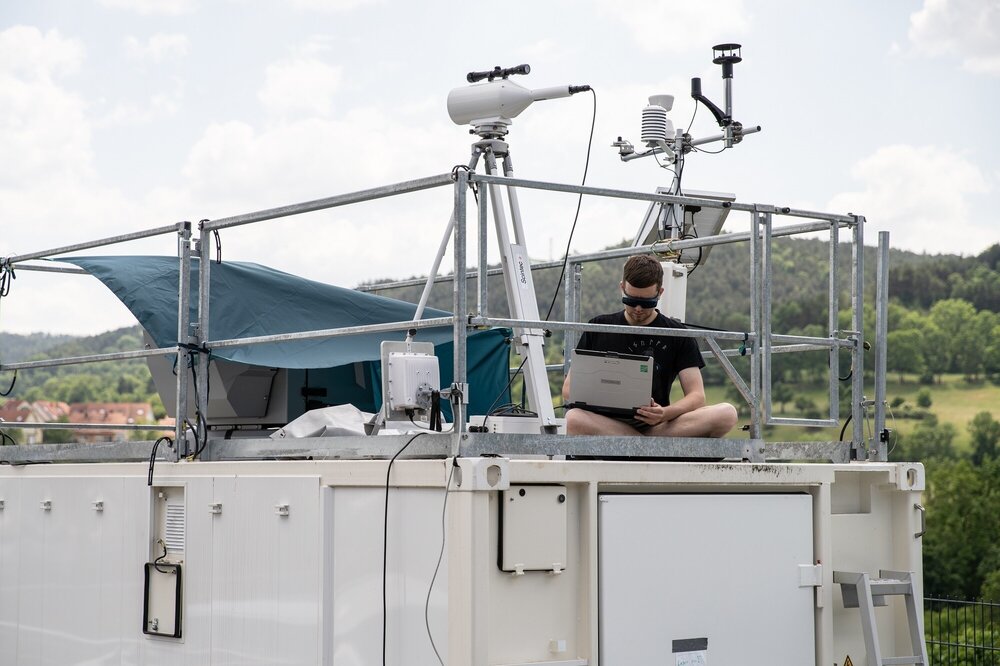
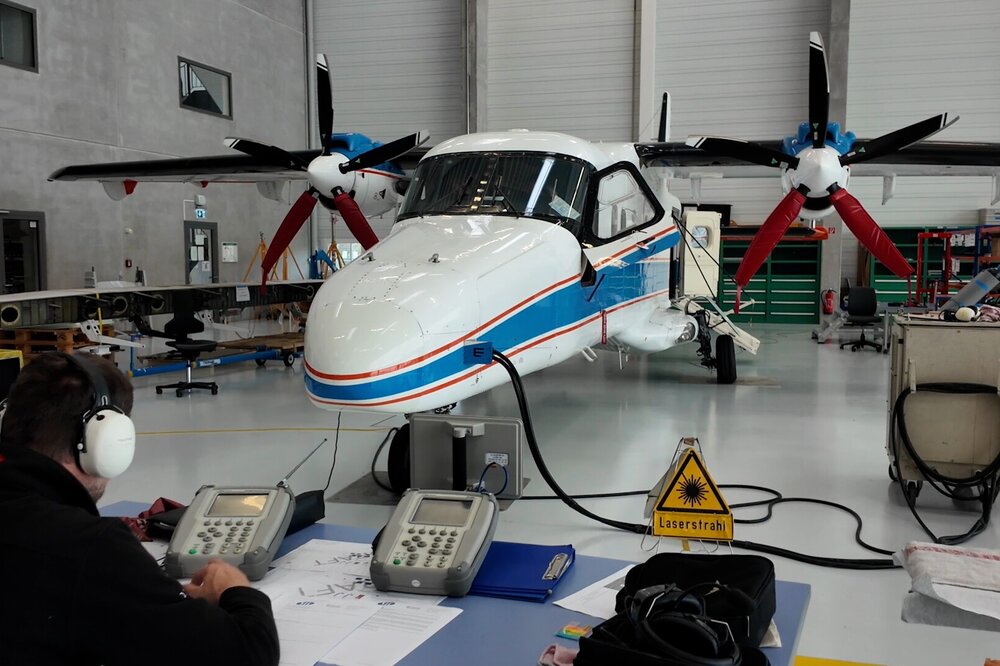
The QuNET initiative has repeatedly attracted public attention. In 2021, for example, it demonstrated a quantum-secured communication link in Berlin's government district. In 2023, it showcased a hybrid quantum connection combining free-space optical and fiber-optic links in Thuringia, as well as a quantum network with multiple nodes and users in Berlin. In 2024 and 2025, a mobile quantum communication node was connected aboard an aircraft in Bavaria. The initiative concluded with a live demonstration in Berlin. Under the leadership of MPL and FAU, researchers interconnected different quantum cryptography systems to form a network, demonstrating a realistic application scenario: fictitious pharmacy billing data from Jena University Hospital was transmitted securely using quantum technology over conventional fiber-optic communication networks to DATEV and the Bundesdruckerei in Berlin. This setup reflected the initiative's fundamental objective: not only to develop components and systems for quantum communication, but also to integrate them into existing infrastructure and make them usable in real-world environments.
Infrastructure Expansion as the Foundation for Future Markets
The development of research infrastructure for quantum technologies is progressing rapidly in many locations.
The Technical University of Munich (TUM), for example, recently opened its new Center for Quantum Engineering (ZQE). As a central scientific institute, it aims to consolidate quantum technology research and bridge the gap between fundamental research and applications in quantum computing, secure
communication, high-precision sensing, and the simulation of new materials. At the same time, the center provides excellent conditions for early-career researchers, further strengthening Munich's position as a leading location for quantum research. The research, involving approximately 100 scientists, focuses on solid-state-based hybrid quantum systems. Three interdisciplinary areas form the foundation of this work: hybrid quantum devices and quantum circuits, functional quantum materials, and the modeling of complex quantum systems.
The State of Bavaria supported construction of the ZQE with approximately EUR 35 million, while the German federal government contributed EUR 20 million. In addition, five research professorships were established for the new center as part of Bavaria's High-Tech Agenda. These investments provide further momentum for the quantum ecosystem in and around Munich, reinforcing Bavaria's role as a driving force behind Europe's quantum agenda.
In Aachen, the quantum internet of the future is also beginning to take shape. As part of the next phase of the Quantum Internet Alliance (QIA), supported by EUR 47.5 million in funding from the European Commission, a full-stack quantum internet prototype is to be developed and prepared for practical deployment. The transfer of quantum networking technologies from the laboratory into application-oriented pilot facilities and open-access infrastructure is another key focus. The Fraunhofer Institute for Laser Technology ILT in Aachen will coordinate the “Pilot Facilities and Open Access” work package. The goal is to establish European pilot facilities and research infrastructure to advance key quantum internet technologies to higher levels of technological maturity. In close cooperation with Delft Networks, researchers in Aachen are further developing low-noise quantum frequency converters for an SnV-based quantum network. Development extends from laboratory setups to rack-integrated demonstration modules capable of transmitting individual photons over telecommunications fibers. With ALICE (Access Link for Interplatform Communication Experiments), Fraunhofer ILT is also providing a hardware-based open-access platform for testing and further developing quantum networking technologies based on an NV network node in Aachen. A junior research group led by Dr. Florian Elsen at the Chair of Laser Technology at RWTH Aachen University is simultaneously working on technologies for connecting different quantum platforms. The group will use ALICE as a trial user, integrating the Aachen quantum network node into its own technology development activities.
Growing Momentum Ahead of World of Quantum
The numerous initiatives, Germany's High-Tech Agenda and the pooling of resources at European level all reflect the growing momentum in quantum technologies. The key players driving this progress will come together in Munich from June 22 to 25, 2027, at World of Quantum, the World's Leading Trade Fair for Quantum Technologies. Right next door, they will meet the photonics pioneers enabling this progress at Laser World of Photonics 2027, the World's Leading Trade Fair and Congress for Photonics Components, Systems and Applications. Register now to be part of it!